
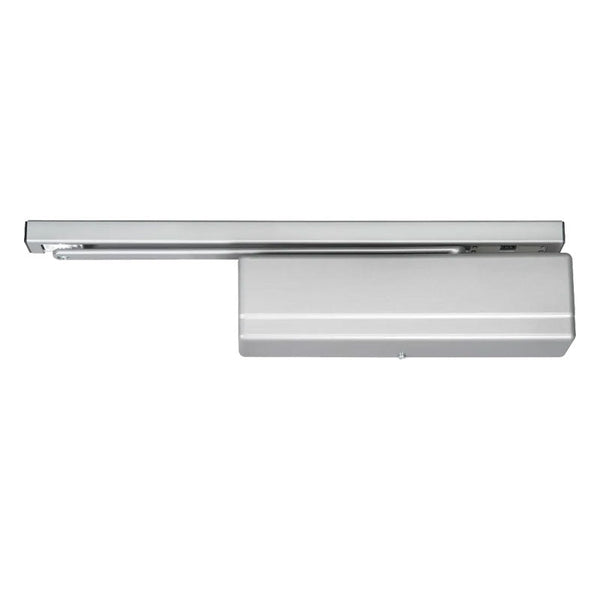
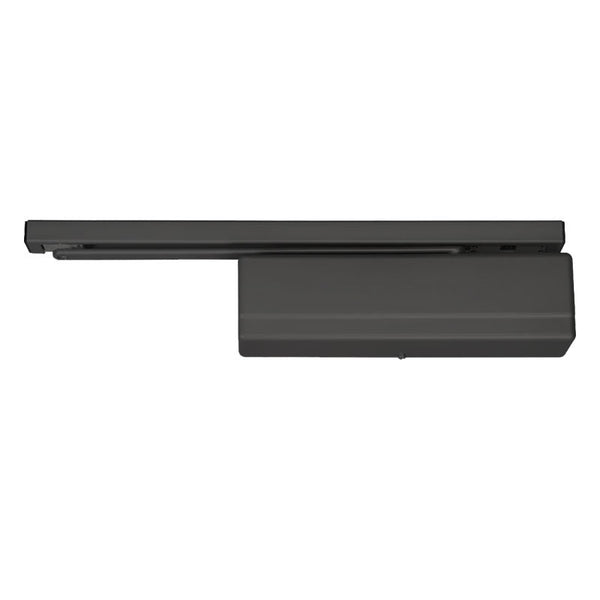
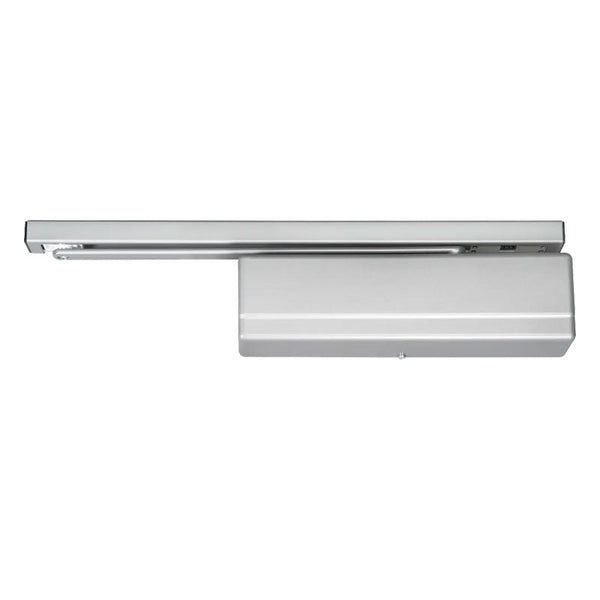
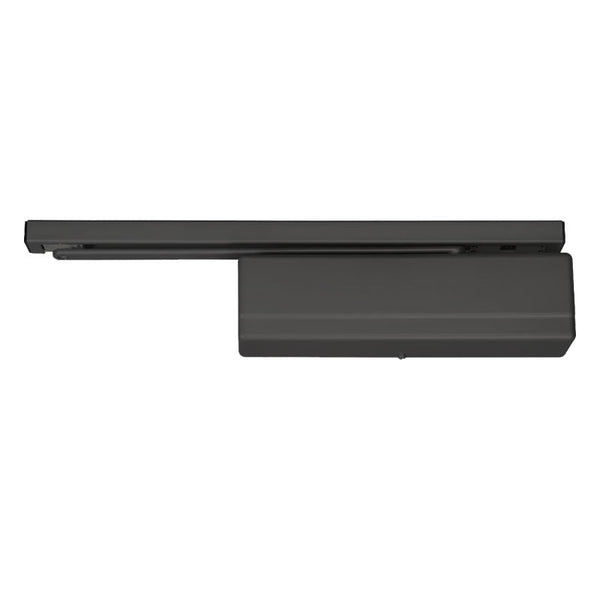
Cam action closers exist for one reason: to make a door easier to open without making it worse at closing. A cam and roller drive replaces the rack and pinion found in conventional closers, shifting the force curve so the hardest part of the swing comes later rather than right at the start. Shop cam action closers, including the Sargent 1431 PowerGlide, in multiple finishes. In stock at Commercial Door Hardware and shipping the same day.
Why a Conventional Closer Feels Heavy
Every door closer is a spring that resists opening and then uses that stored energy to close the door. The question is where in the swing the resistance peaks.
A rack and pinion closer links the arm to a pinion gear driving a rack against the spring. The mechanical relationship means resistance is highest at the very start of the opening swing, which is the exact moment a person applies force from a standstill. The door feels heavy for the first few inches and then eases.
A cam action closer uses a cam and roller instead. The cam profile changes the relationship between arm rotation and spring compression, so peak resistance moves later into the swing. Once the door is moving, momentum carries it, so the later resistance is far less noticeable than the same resistance at the start.
|
Feature |
Cam action |
Rack and pinion |
|---|---|---|
|
Drive |
Cam and roller |
Rack and pinion gear |
|
Peak resistance |
Later in the opening swing |
At the start of the swing |
|
How the door feels |
Easier to start moving |
Heavier initially, then eases |
|
Closing control |
Hydraulic sweep, latch, backcheck |
Hydraulic sweep, latch, backcheck |
|
Closing power |
Not reduced |
Not reduced |
|
Typical specification |
Accessible and low-force openings |
General commercial openings |
The critical point: cam action doesn't reduce closing power. Both designs close the door hydraulically with the same adjustments. Cam action changes the opening feel, not the closing performance.
Why Not Just Turn the Spring Down
This is the question that explains the whole product category.
You can reduce spring power on a conventional closer, and on some openings that's enough. But spring power does two jobs: it resists opening, and it closes the door. Turn it down, and both change together. Reduce it far enough to meet a low opening force requirement, and you may no longer have enough power to close the door against its weatherstripping, overcome latch resistance, or hold against stack pressure in a stairwell.
That's the trap. A door adjusted light enough to open easily but too light to latch has failed, and on a rated opening it's a code violation rather than an inconvenience.
Cam action breaks the link by addressing the mechanism rather than the spring setting. You get the lower opening force and keep the closing power.
Where Cam Action Is Specified
-
Accessible entrances with opening force limits.
-
Healthcare facilities where patients and visitors use the doors.
-
Senior living, assisted living, and memory care resident and common doors.
-
Elementary schools where young children operate the doors.
-
Rehabilitation facilities and physical therapy areas.
-
Public buildings including libraries, community centers and civic buildings.
-
Accessible restrooms on accessible routes.
-
Exterior doors with heavy weatherstripping where closing power must stay high.
-
Doors that generate complaints about being too hard to open.
Available Finishes
|
Code |
Finish |
Where it fits |
|---|---|---|
|
689 |
Aluminum painted |
The most widely stocked closer finish |
|
690 |
Dark bronze painted |
Bronze framing and darker schedules |
|
693 |
Black painted |
Dark hardware schedules |
|
696 |
Satin brass painted |
Brass hardware schedules |
|
BSP |
Black suede powder coat |
Contemporary interiors |
|
WSP |
White suede powder coat |
White painted frames and light interiors |
-
689 aluminum is the default and carries the deepest stock.
-
Painted and powder coat finishes can be touched up if scratched during installation.
-
Confirm availability for your specific model and arm configuration on the product page.
-
Match the closer to the hinges, lockset, and other hardware on the opening.
Benefits of Cam Action
-
Lower opening force at the start of the swing, where people feel it.
-
Full closing power retained, so the door still latches reliably.
-
Supports accessibility requirements without compromising the closing function.
-
Suits doors with weatherstripping, where closing power can't be reduced.
-
Full hydraulic control, with the same sweep, latch, and backcheck adjustments.
-
Surface-mounted, installing and servicing like any other surface closer.
-
Fewer complaints on openings used by people with limited strength.
-
Ready to ship. In-stock closers ship the same day
Why Order Cam Action Closers from Commercial Door Hardware
Commercial Door Hardware supplies door hardware for schools, healthcare facilities, offices, retail and institutional buildings, carrying closers, locks, exit devices, hinges, continuous hinges, thresholds and gasketing from Sargent, LCN, Norton, Corbin Russwin, Accentra and Pemko.
Accessible openings are a system, not a closer. The same door often needs smoother hinges or a continuous hinge, a threshold within height limits, gasketing that seals without over-compressing, and hardware that operates without tight grasping or pinching. Sourcing those together means they're specified to work with each other rather than fighting one another.
Everything in this collection is in stock at Commercialdoorhardware.com and ships the same day.