
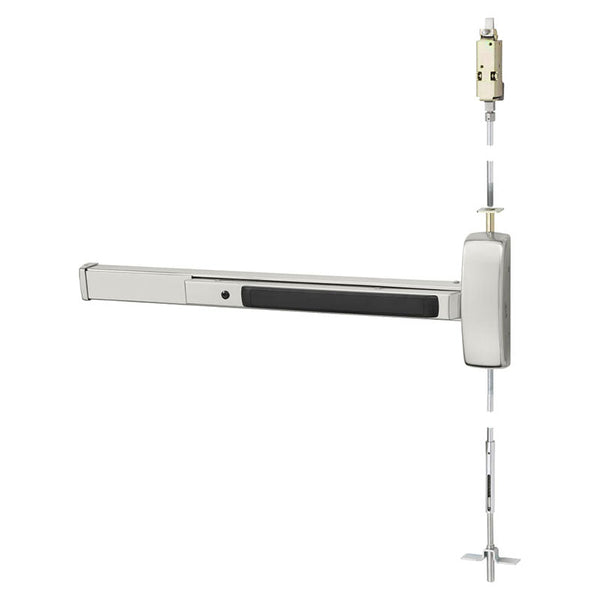
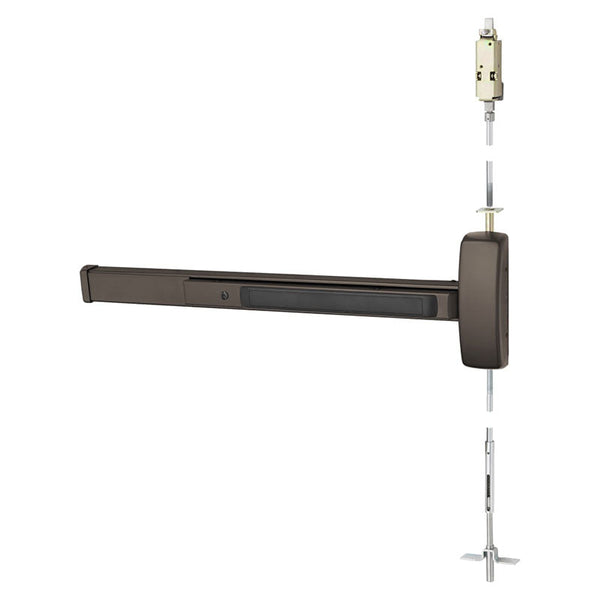
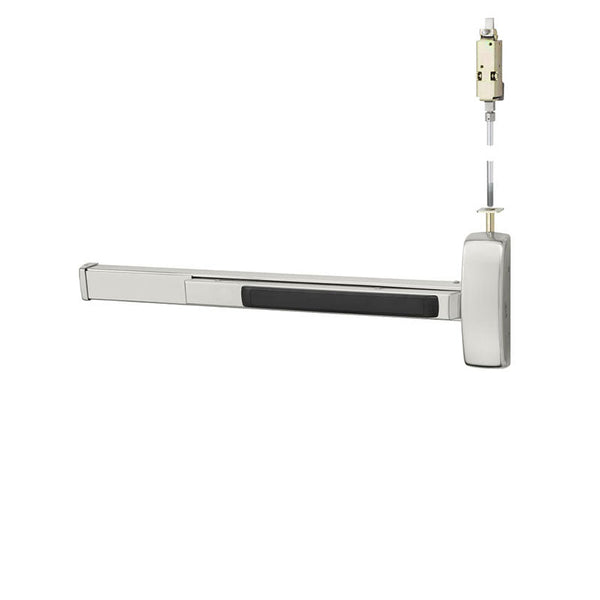
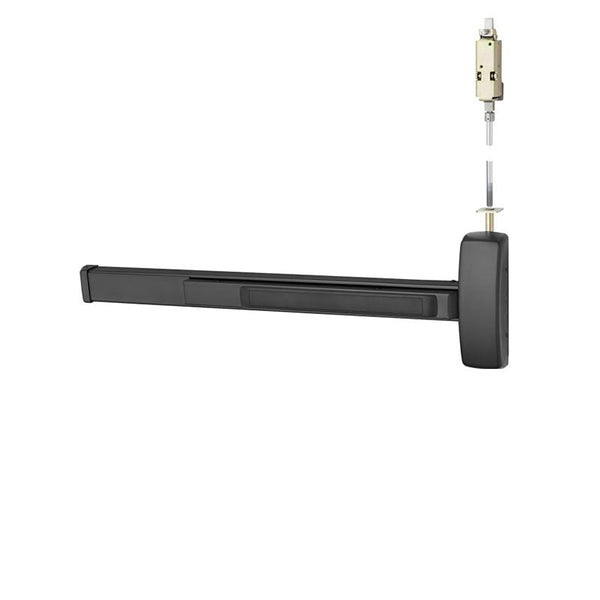


A concealed vertical rod exit device hides its rods inside the door, latching at the top and bottom while leaving the door face clean. Shop Sargent concealed vertical rod exit devices, including the AD8600 for aluminum doors, MD8600 for metal doors, and WD8600 for wood doors, plus the 8400 Series for narrow stile applications, in 7- and 8-foot heights and 36, 42, and 48-inch bar widths. In stock at Commercial Door Hardware and shipping the same day.
How Concealed Vertical Rod Devices Work
A rim exit device latches into a strike on the frame. That's simple and reliable, but it needs a frame to latch into, which is a problem on a pair of doors without a mullion: there's nothing in the middle to catch.
A vertical rod device solves that by latching at the top and bottom of the door instead. Rods run from the push bar up to a top latch and down to a bottom latch, so the door secures against the frame head and the floor or threshold rather than against a strike in the middle of the opening.
Concealed rods run inside the door itself. Surface rods run along the door face. Both latch the same way, but they look and behave differently in use.
|
Feature |
Concealed vertical rod |
Surface vertical rod |
|---|---|---|
|
Rod location |
Inside the door |
On the door face |
|
Appearance |
Clean, nothing visible on the door face |
Rods visible top and bottom |
|
Vandalism exposure |
Rods are protected inside the door |
Rods can be struck, bent or tampered with |
|
Cleaning |
Nothing on the face to collect dust |
Rods and guides collect dust and debris |
|
Door preparation |
Door must be prepped for concealed rods |
Mounts to a prepared door face |
|
Retrofit |
Usually specified at the door |
More straightforward to retrofit |
Concealed rods are specified where appearance matters and where rods on the face would be damaged. The trade-off is preparation: the door has to be built or prepped for them.
Choosing by Door Material
Sargent splits the 8600 Series by what the door is made of, because the rod channel and preparation differ.
|
Series |
Door material |
Typical opening |
|---|---|---|
|
AD8600 |
Aluminum doors |
Storefront and curtain wall entrances |
|
MD8600 |
Metal doors |
Hollow metal doors in commercial and institutional buildings |
|
WD8600 |
Wood doors |
Wood doors in offices, schools and healthcare |
|
8400 Series |
Narrow stile doors |
Aluminum and glass doors with limited stile width |
Identify the door material first. A device built for a wood door won't suit an aluminum storefront, and the 8400 Series exists because narrow stile doors can't accept a wide stile device at all.
The NB Option: Less Bottom Rod
A bottom rod runs to the floor, which means it sits in the path of everything that crosses the opening: mop water, cart wheels, grit, floor scrubbers. On high-traffic doors, bottom rods and their latches are the part that fails first.
The NB option reduces bottom rods, removing that failure point. It's commonly specified on hospital corridors, school restrooms, loading areas and anywhere floors are washed frequently. Confirm the configuration and any strike requirements against the device's specifications for your opening.
Options and Accessories
Sargent identifies options by prefix or number.
|
Code |
Option |
What it does |
|---|---|---|
|
AL |
Alarm |
Built-in alarm sounding when the device is used |
|
PL |
SARGuide photoluminescent coating |
Glows in the dark after light exposure, marking the device during a power loss |
|
TL |
SARGuide illuminated touchpad |
Illuminated push surface |
|
53 |
LX latchbolt monitoring |
Reports latchbolt position to the access control system |
|
54 |
Outside lever monitoring |
Reports outside lever operation |
|
55 |
Request to exit with rail monitoring |
Signals the system that someone exited through the door |
|
56 |
Remote latch retraction |
Retracts the latch electrically for card reader or operator sequencing |
|
58 |
Electric dogging |
Holds the latch retracted electrically instead of mechanically |
|
59 |
Electroguard with self-contained delayed egress |
Delays egress where permitted, with the control built into the device |
Electric dogging (58) and remote latch retraction (56) are the options that matter on access-controlled openings, since neither relies on mechanical dogging, which fire-rated doors don't permit. Delayed egress (59) is tightly regulated by occupancy and alarm interface, so confirm it with your authority having jurisdiction before specifying.
Sizes and Functions
|
Attribute |
Options |
|---|---|
|
Door heights |
7 foot and 8 foot |
|
Exit bar widths |
36", 42" and 48" |
|
Functions |
Classroom, exit only, storeroom, passage, and multi-function configurations |
|
Dogging |
Hex key dogging and less dogging |
|
Keyway |
LA keyway and other Sargent keyways |
Available Finishes
|
Code |
Finish |
Where it fits |
|---|---|---|
|
US32D / 630 |
Satin stainless steel |
The standard commercial exit device finish, resists wear and frequent cleaning |
|
US10BE / 613E |
Bronze |
Bronze entrances and darker hardware schedules |
|
BSP |
Black suede powder coat |
Contemporary interiors and dark hardware schedules |
|
WSP |
White suede powder coat |
White painted frames and light-toned entrances |
-
US32D/630 satin stainless is the default on most commercial openings and carries the deepest stock, since an exit device is touched constantly and stainless outlasts painted finishes.
-
US10BE/613E bronze matches bronze anodized storefront framing, which is common on aluminum door openings taking the AD8600.
-
BSP and WSP powder coats suit openings where the device should blend with a painted frame rather than contrast against it.
-
Match the device finish to its trim, since the two are seen together from opposite sides of the same opening.
Benefits of Concealed Vertical Rod Devices
-
Clean door face. Nothing visible on the door, which suits contemporary and architectural entrances.
-
Latches top and bottom, so pairs without a mullion still secure properly.
-
Rods are protected inside the door, out of reach of abuse and tampering.
-
Less cleaning. No rods or guides on the face collecting dust and debris.
-
Grade 1 construction on the 8600 Series for high-traffic commercial openings.
-
Material-specific versions for aluminum, metal and wood doors.
-
NB option removing bottom rods on openings where floor conditions destroy them.
-
Electrified options including latch retraction, electric dogging and monitoring.
-
Four finishes covering stainless, bronze and two powder coats.
-
Ready to ship. In-stock devices ship the same day.
Applications
-
Pairs of doors without a mullion, where a rim device has nothing to latch into.
-
Storefront and curtain wall entrances using the AD8600 on aluminum doors.
-
School and university corridors needing Grade 1 durability.
-
Healthcare facilities where the NB option avoids bottom rod failures from floor cleaning.
-
Office lobbies and architectural entrances where visible rods would spoil the appearance.
-
Access-controlled openings using remote latch retraction or electric dogging.
-
Doors with automatic operators, where the latch must retract before the operator swings the door.
-
Stairwells and rated corridors using fire-rated configurations.
Why Order Sargent Exit Hardware from Commercial Door Hardware
Commercial Door Hardware supplies door hardware for schools, healthcare facilities, offices, retail and institutional buildings, carrying exit devices, locks, closers, hinges, pivots, thresholds and weatherstripping from Sargent, Von Duprin, Corbin Russwin, Accentra, Schlage, LCN, Norton, Pemko and others.
Vertical rod openings in particular are rarely just a device. A pair of doors needs the devices, the right trim, top and bottom strikes, a coordinator so the leaves close in sequence, closers on both leaves, and often an astragal and threshold. Ordering those from one supplier means they arrive together, match in finish, and are specified to work as a set.
Everything in this collection is in stock at Commercialdoorhardware.com and ships the same day. If you're replacing an existing device, send us the model number and the door material, and we'll confirm the right series, size, and configuration before you order.